

The Campfire Effect

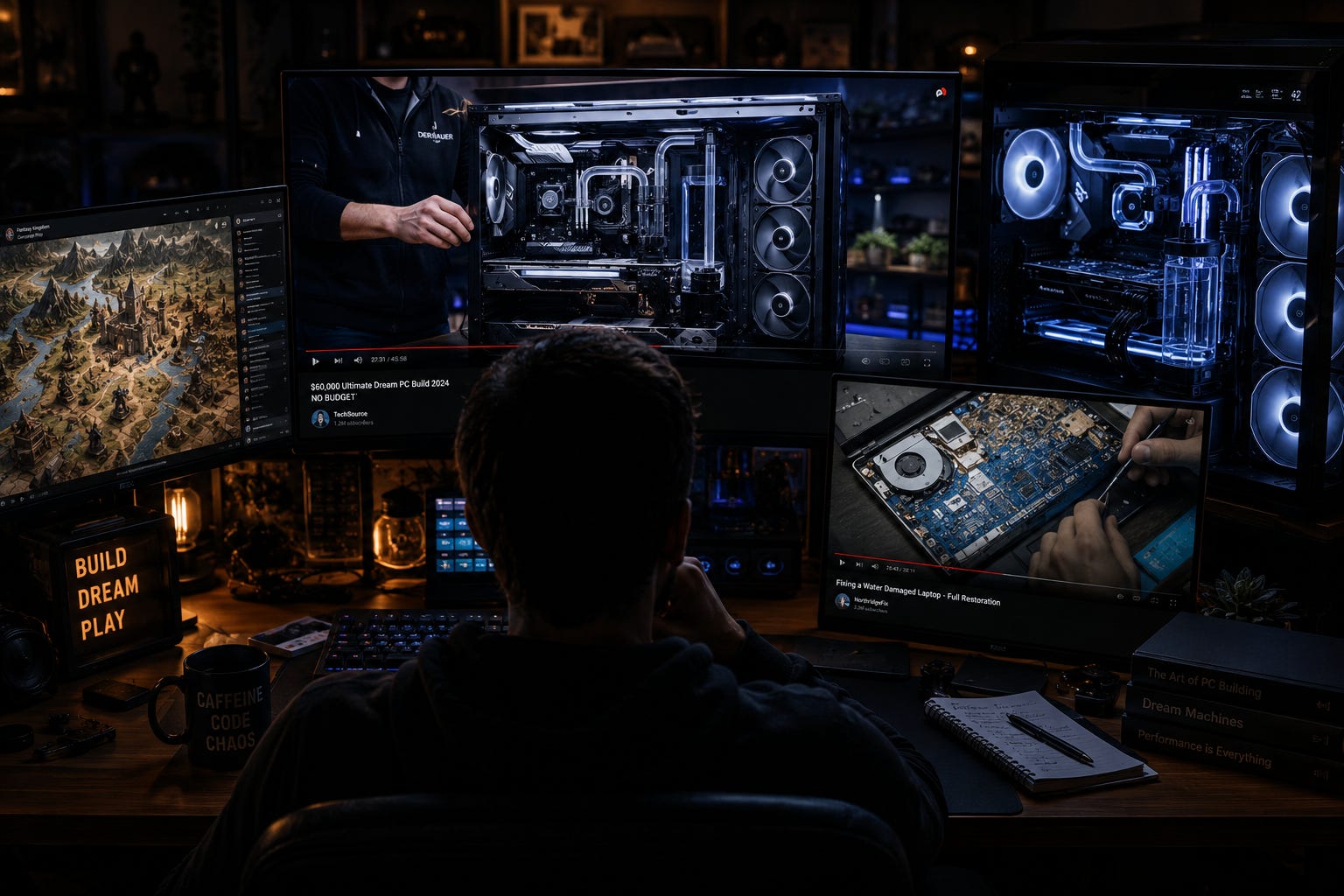
Last night, I made a mistake.
Not a serious mistake. Nothing involving money, sharp objects, or accidentally replying-all to a company email. Those days are thankfully behind me.
No, my mistake was clicking on a video of someone building a custom gaming PC. Not an ordinary gaming PC, mind you. This wasn’t a practical machine assembled by someone operating within the same financial reality as the rest of humanity. This was a full-blown technological fever dream. A no-budget, consequences-be-damned, “what if we simply purchased all the best parts on Earth and put them in the same case” kind of build.
The video itself was pure ASMR for technology enthusiasts. Soft clicks as components slid into place. The gentle peel of protective plastic. Perfectly routed cables disappearing into hidden channels like some form of digital sorcery. At one point I was more than certain the graphics card cost more than my first car.
It was, in short, a tech nerd’s version of luxury pornography.
I have absolutely no need for a sixty-thousand-dollar computer. Yet there I sat, completely captivated as a stranger assembled a machine powerful enough to calculate the trajectory of a small moon while simultaneously rendering every blade of grass in a fantasy kingdom.
Three hours later, I found myself watching a man in Germany repair a laptop that looked as though it had spent several months at the bottom of a lake.
I don’t need another computer. I already have enough computing power in my office to launch a small moon mission. Yet there I sat, completely engrossed as a stranger methodically tested circuits, replaced components, and brought a dead machine back to life.
At some point, the algorithm decided I might also enjoy watching someone build an elaborate fantasy gaming table. The algorithm was correct.
Then came a video about custom water cooling.
Then a restoration project.
Then another.
Before I knew it, 3am had arrived and I was left asking a question that many of us have probably asked ourselves:
Why are these videos so enthralling?
The obvious answer is that they’re satisfying. Humans love watching things get fixed. We enjoy seeing problems solved. There’s something deeply pleasing about watching a pile of disconnected parts become a working machine.
But I suspect there’s something more going on.
For most of human history, knowledge wasn’t something you searched for. It was something you watched.
If you wanted to learn how to hunt, build a shelter, make a tool, sew a garment, or bake bread, you sat beside someone who knew what they were doing and observed. Skills were passed from one generation to the next through demonstration. The village blacksmith wasn’t just making horseshoes. He was also teaching anyone paying attention.
Our ancestors spent thousands of years learning by watching skilled people work.
Then along came the internet.
What is YouTube if not the world’s largest collection of apprenticeships?
Millions of people voluntarily spend their evenings watching experts do things they will never personally attempt. We watch woodworkers build furniture despite having no workshop. We watch mechanics rebuild engines despite barely knowing where our oil dipstick is located. We watch chefs create elaborate meals before wandering into the kitchen and making a sandwich.
The subjects change. The instinct remains.
The brain likes competence.
It especially likes visible competence.
That distinction matters.
Many modern jobs have become strangely invisible. I spent four decades working in technology. If someone had walked into my office twenty years ago and asked what I was building, the answer would have involved databases, financial systems, networks, and enough acronyms to induce a migraine.
The problem is that most of that work didn’t look like work.
At the end of a long day, there was often nothing tangible to point at. No chair had been built. No engine had been repaired. No wall had been painted.
A great deal of modern work happens inside screens and spreadsheets. Important things are accomplished, but the process can feel abstract.
That’s why these videos resonate so strongly.
They provide visible progress.
A broken laptop becomes functional.
A pile of components becomes a gaming computer.
An empty table becomes a fantasy world.
Cause and effect unfold before our eyes.
Human beings love transformation stories. In many ways, every story ever told follows the same basic structure. Something begins in one state and ends in another. The hero changes. The world changes. The problem is solved.
A repair video is simply that formula with fewer dragons.
Though sometimes only slightly fewer dragons.
There’s also a curious relationship between these videos and technological progress itself.
Every generation has watched increasingly sophisticated tools emerge. What once required a team of engineers now fits on a desktop. What once filled an entire room now fits in a pocket. The modern PC builder isn’t merely assembling hardware. They’re participating in a long chain of innovation stretching back decades.
Every motherboard, graphics card, processor, and cooling system represents thousands of accumulated breakthroughs.
And yet what captivates us isn’t the technology.
It’s the builder.
The machine is impressive. The human is more impressive.
That may be why technology enthusiasts become particularly vulnerable to these rabbit holes. We tell ourselves we’re interested in specifications, benchmarks, thermal performance, or frame rates. Then we spend two hours watching someone route cables with the precision of a Renaissance sculptor.
Deep down, we aren’t admiring the computer.
We’re admiring mastery.
The same thing happens when people watch artists paint, musicians perform, chefs cook, or craftspeople restore antique furniture. Competence is attractive. Expertise is fascinating. Watching someone who truly understands their craft reminds us of what human beings are capable of when curiosity and persistence intersect.
Perhaps that’s why these videos feel strangely comforting during uncertain times.
The world often appears chaotic. News cycles move at dizzying speed. Technology changes faster than many of us can keep up with. Entire industries seem to transform overnight.
Yet inside these videos, order prevails.
Problems have solutions.
Broken things can be repaired.
Confusing systems can be understood.
The world makes sense again, at least for fifteen minutes.
Or three hours, if you’re anything like me.
When our ancestors gathered around campfires thousands of years ago, they watched skilled members of their communities work, tell stories, and pass along knowledge. Today, the fire has been replaced by a glowing screen, and the storyteller might be rebuilding a graphics card instead of shaping a spear point.
The technology has changed.
The human instinct has not.
We’re still gathering around the fire.
We’re still watching.
And occasionally, we’re still looking up at the clock in disbelief and wondering where the evening went.